
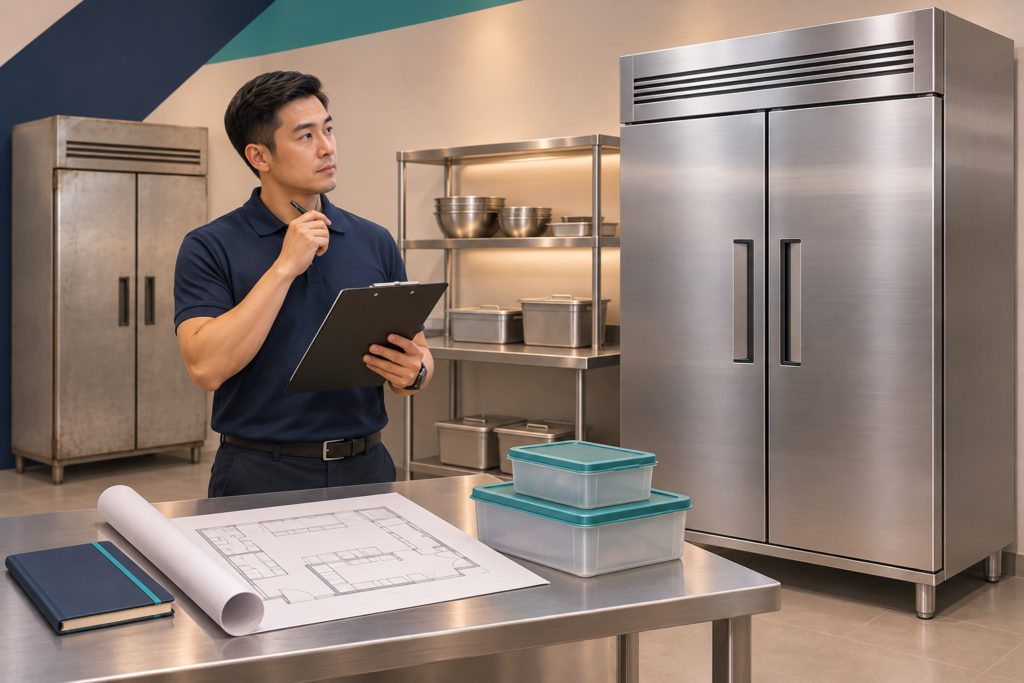
Replacing a restaurant refrigerator is a handover between two working systems. Your kitchen still needs somewhere to keep ingredients, staff need access to their stations, and the replacement must be ready before stock moves back. A delivery booking alone does not settle those questions.
For Singapore restaurant owners, café operators and procurement managers, a clear changeover brief helps turn an equipment enquiry into a workable proposal. It gives the supplier the information needed to discuss the unit, the site and the sequence of work together.
Use the following plan for replacing a self-contained commercial chiller or freezer in an operating kitchen. Cold rooms and major layout changes need a separate project assessment.
Start with an operating brief, not just a model number
Photograph the existing unit and its identification plate. Record what it stores, how staff use it and what has changed since it was purchased. A cabinet that was adequate for the opening menu may no longer suit today’s delivery pattern or preparation volume.
Describe the replacement requirement in practical terms:
- Chilled or frozen storage, with the required conditions for the actual food.
- The containers and quantities that must fit during the busiest shift.
- Door-opening frequency and which kitchen station needs access.
- Current problems, supported by service reports or temperature records where available.
- The available replacement window and the next service that depends on the cabinet.
If you are unsure whether replacement is necessary, request an assessment of the existing equipment. U-Save lists equipment maintenance services; confirm the scope and any assessment charges directly.
Keep general model selection separate from the changeover plan. U-Save’s commercial refrigeration page is a starting point for discussing the equipment options.
Use three handover checkpoints
Checkpoint 1: Where will the stock go?
Before authorising disconnection, name the person responsible for the ingredients and confirm their temporary storage destination. Check usable space in that destination rather than assuming another cabinet has enough spare capacity.
Identify which stock can be reduced through purchasing and production planning before the move. Keep raw and ready-to-eat items appropriately separated, and maintain the conditions required by the food and your operating procedures throughout the transfer.
SFA’s guidance for food business operators stresses correct storage conditions and accurate temperature monitoring. For the changeover, agree how staff will check and record those conditions. Do not treat a switched-on replacement cabinet as evidence that it is ready for loading.
The decision at this checkpoint is simple: if the agreed storage arrangement is unavailable, who can postpone the move or authorise the contingency? Settle that before the delivery team arrives.
Checkpoint 2: Can the old unit leave and the new unit enter?
Measure the route from the unloading point to the final position, including doors, turns, lift access and changes in floor level. Supply photographs showing obstacles and the surrounding workspace. Ask the supplier to confirm the relevant transport dimensions and handling arrangements for the proposed model.
Also check the final installation position. The installer should verify the model’s electrical requirements, ventilation clearances, service access and any drainage needs against its documentation. Matching the old cabinet’s outside dimensions does not confirm that the new unit is suitable.
For premises with managed access, ask building management about loading-bay bookings, goods-lift arrangements, permitted work hours and required contractor paperwork. Record who obtains each confirmation.
Then agree the sequence: stock transfer, safe disconnection, old-unit removal, site preparation, new-unit placement and connection. Ask which parts of that sequence are included in the quotation. U-Save offers planning and installation services; the actual responsibilities and timing should be confirmed for your project.
Checkpoint 3: Who releases the cabinet for use?
Agree the acceptance checks with the supplier before delivery. These should address the correct model, visible condition, placement, connections, door operation and the manufacturer’s startup instructions.
Ask the installer to explain when the cabinet may be loaded and how the kitchen should verify operation under its intended conditions. Startup or settling instructions depend on the equipment and how it was transported; avoid planning around a universal waiting time.
Nominate a kitchen representative to receive the operating instructions, record the equipment details and approve the stock-transfer step. Keep any unresolved issue on a written handover list with an owner and next action.
Compare the replacement scope line by line
Two equipment quotations may cover different work. Use a shared scope checklist so the comparison reflects the complete changeover.
| Item to confirm | Question for the supplier |
|---|---|
| Replacement equipment | What exact model, configuration and documentation are included? |
| Site preparation | What must be completed before the delivery visit? |
| Access and handling | Are special access arrangements or additional handling included? |
| Old equipment | Who disconnects, removes and arranges disposal of the old unit? |
| Connection and startup | Who performs the work and records the handover checks? |
| Scheduling | What is confirmed, what is provisional, and what happens if work overruns? |
| After-sales terms | What written warranty, exclusions, service arrangements and contacts apply? |
For a new model within NEA’s regulated commercial storage refrigerator category, request its registration and energy-label information. NEA’s regulated goods definition distinguishes these storage appliances from customer-display applications and excludes second-hand goods from that category. Confirm the classification of the actual equipment rather than applying one rule to every refrigerated cabinet.
Use documented energy information when comparing suitable models. It does not establish your restaurant’s future electricity bill or a guaranteed saving.
Send a brief that supports a useful quotation
Bundle the operating requirement and site information into one enquiry. Include your business type, site location, existing-unit photographs, required storage use, measured space and access-route photographs. Add your normal service hours, preferred changeover dates and any building restrictions already confirmed.
State whether temporary stock storage is arranged and whether old-unit removal needs to be quoted. If a detail is unknown, mark it for the site assessment. A clear unknown is more useful than an assumed dimension or electrical requirement.
For a hotel or multi-outlet business, identify both the purchasing contact and the on-site person who can answer operational questions. This helps prevent a commercially approved order reaching a kitchen that is unprepared for the work.
Frequently asked questions
Can we replace a commercial refrigerator between services?
Possibly, but confirm access, work scope, startup requirements and temporary storage before committing. Include an agreed response if the next service cannot use the replacement as planned. Delivery time and readiness for use are separate milestones.
Should we order the same size as the old refrigerator?
Use the old unit as reference information. Recheck usable storage, the current workload, access and the proposed model’s installation requirements. A similar footprint alone is insufficient.
Does a replacement quotation include disposal and temporary refrigeration?
Ask explicitly. Do not assume that either is included in equipment supply or installation. Confirm availability, responsibility and any separate charges in writing.
What should we keep after handover?
Keep the model and serial details, manuals, quotation, agreed warranty terms, service contacts and acceptance records. Add the new cabinet to your equipment register and follow its operating and maintenance instructions.
Discuss your replacement with U-Save
Contact U-Save F&B Equipment with your current-unit photos, storage requirement and site constraints. Ask for a proposed replacement and a clearly defined changeover scope. Confirm model suitability, availability, installation arrangements and written commercial terms before placing the order.