
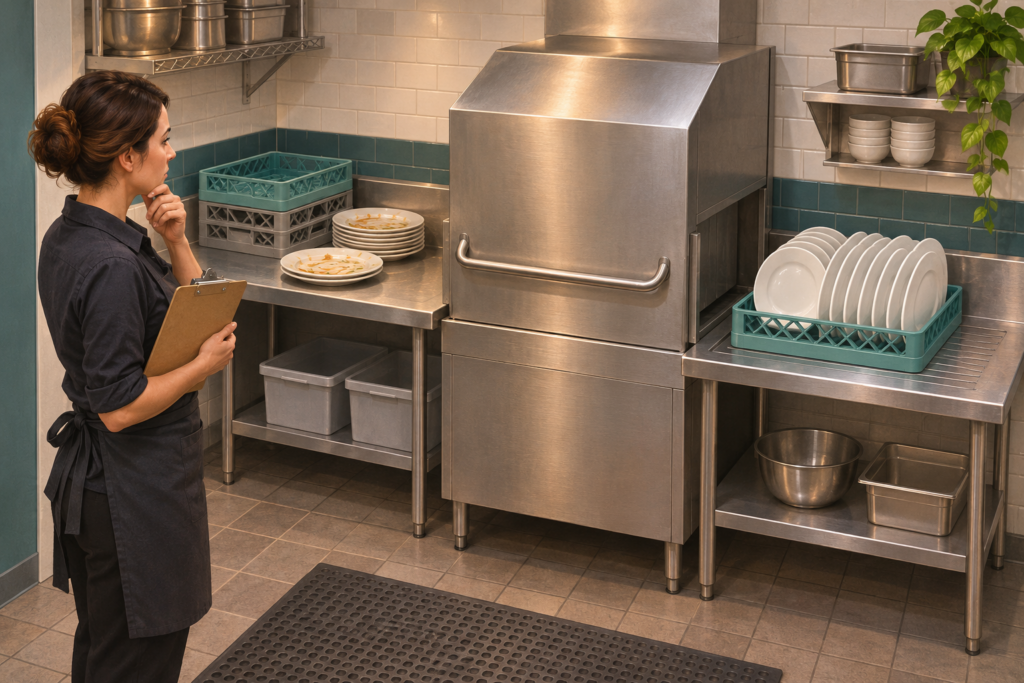
At the end of a busy dinner service, your team may be waiting for clean plates while the dishwashing area fills up with racks. A faster dishwasher could help if the machine is already cycling steadily and still cannot keep up. But a queue can also form because the next rack is never ready, the machine keeps pausing, or there is nowhere to unload clean ware.
If you run a Singapore restaurant or café with a rack-based commercial dishwasher, watch one representative rush before asking for a larger machine. A short record of where work waits can help you choose between changing the workflow, arranging a service assessment and comparing equipment capacity.
Follow the racks through one busy service
Pick a period when the problem usually happens. Start a little before the rush so you can see when the first queue forms. Continue until the station catches up or the shift ends. Have a supervisor tally from a safe spot without interrupting the people handling the ware. Record the service context, such as a function finishing at once, a different menu or fewer staff than usual.
Follow the rack from dirty return and preparation to washing, unloading and clean storage. Keep clean and dirty handling separate. Hobart’s dishroom guide describes separate dirty and clean sides and space for ware to dry. Winterhalter’s operating guide also stresses using suitable racks, loading them correctly and allowing the wash programme to finish. Follow the instructions for your own machine and your site’s hygiene procedures throughout the observation.
Use the same count at each interval
| What to record | How to count it |
|---|---|
| Demand arriving | Tally rack equivalents for incoming plates, glasses and other ware separately, using your normal rack layout. Where a pile is difficult to estimate, note the ware count and flag it as an estimate. |
| Accepted output | Count racks whose contents are accepted under your usual checks. Count a rack that needs another pass once, when it clears. Record repeat cycles separately. |
| Queue at the end of the interval | Note dirty ware waiting to be prepared, loaded racks waiting to enter and finished racks waiting for unloading. Keep these locations separate. |
| Idle time and interruptions | Write down when the machine is ready without a rack, when it is blocked at unloading and when it displays a fault or stops unexpectedly. Record the programme used. |
| Context | Record staffing, rack availability, bulky items, changes in ware mix and whether service ran out of a particular item. |
Use fixed intervals, such as 15 minutes, so you can compare one period with the next. Rack equivalents are rough planning units. Ten racks of cups can represent a different workload from ten racks of pans. Keep the mix visible when you send your notes to a supplier.
For example, suppose one 15-minute interval brings in about 11 rack equivalents and produces seven accepted racks. The unfinished workload grows by about four rack equivalents, assuming you counted all ware entering and leaving the station in the same units. If the machine sat ready for much of that interval, investigate why racks were missing or blocked. If it kept running, look at the reasons for repeat cycles and whether loaded racks were consistently waiting. This is an illustrative count, with no assumed machine rating.
Use the queue to decide what to check first
Dirty ware builds up and the machine waits for a rack
Look at how dishes arrive, who sorts them, where scraping happens and whether the right baskets are free. For example, if glass racks are all on the clean side waiting to be emptied, adding a second person at the dirty end may do little. If mixed ware arrives in tubs and sorting takes up most of the interval, changing how staff return it may be a better first trial.
Change one practical thing and observe a comparable service again. Keep the usual loading and hygiene procedures so the two observations reflect a genuine workflow change.
The machine stops or racks repeatedly come back
Record the display message, time, programme and what happened immediately before the interruption. For repeat washes, note whether the issue affects one type of ware, one loading pattern or several loads. Staff should limit their checks to the operator tasks in the manufacturer’s instructions. If a fault or wash-quality concern persists, follow your site’s procedure for removing affected ware from use and ask for a professional assessment. U-Save lists equipment maintenance services. Share the observations and confirm the service scope for your equipment.
Clean racks have nowhere to go
Check the space for unloading, draining and moving dry ware back into service. Find out who is responsible for clearing that side during the rush. If a finished rack blocks the next one, an advertised cycle improvement will have limited value until the exit clears. Keep the clean route separate from incoming dirty ware when testing a layout change.
The machine runs steadily and loaded racks keep waiting
If correct loading and accepted output hold steady, faults and rewash are uncommon, and the clean side keeps moving, ask a supplier to assess capacity. Send the busiest consecutive intervals as well as the daily total. Ask how a proposed machine would handle the actual ware mix and programme, including loading, unloading and any practical limits at your site. The headline racks-per-hour figure is a starting point for that discussion. Compare it with the expected accepted output for your shift.
Frequently asked questions
Should I multiply a 15-minute count by four?
You can use the result as a rough hourly pace for that interval. Check the surrounding intervals and how long the queue lasts. A short wave of plates after a function ends has a different impact from an hour of sustained arrivals.
What if plates run out even when the machine catches up?
Track the missing item separately. It might be waiting to dry or return to service, or the opening stock may be too small for the way tables turn. A total rack count can hide a shortage of a particular plate, glass or utensil.
Should I ask about repairs or a higher-capacity machine first?
Share the log with a service provider if you observed interruptions or inconsistent results. A steady machine with correctly loaded racks continually waiting gives you a better basis for a capacity discussion. If both occur, assess the faults first so you can measure capacity under normal operation.
Send your observations to U-Save
Contact U-Save F&B Equipment with the existing machine model, your busiest intervals, the ware mix, any error messages and a simple sketch or photos of the station. State which items ran short and where racks waited. If the log points to a sustained capacity gap, use the commercial dishwasher page to start discussing equipment options. Ask what site checks and operating assumptions the recommendation depends on before requesting a model-specific quote.