
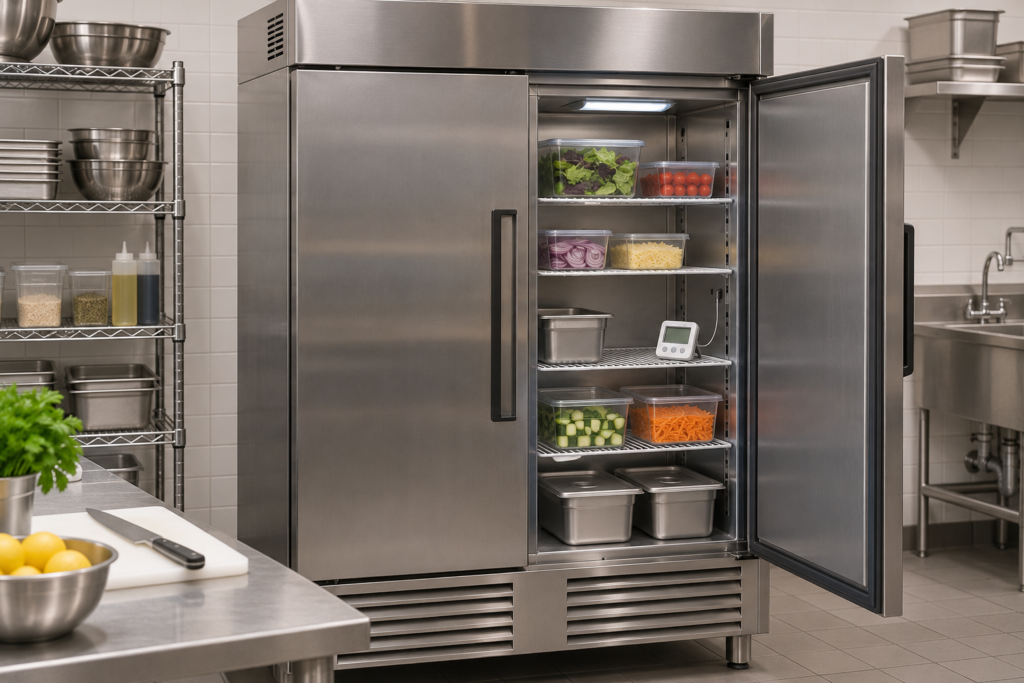
A temperature logger gives your kitchen a record of the conditions at its sensor. Before paying for a logger or including one in a commercial chiller quotation, decide what that location needs to tell you. A sensor close to the door may show what happens during frequent access. A sensor farther inside may help you investigate conditions around a particular group of shelves. Start with an operating question and use the answer to agree on placement, access and record ownership.
Define the observation you need
Write down the reason for collecting readings. A restaurant may want to compare two usable storage positions during lunch service. A production kitchen may want a record for a particular storage zone over an entire shift. The question should name the cabinet, the storage area, the typical load and the period of interest. If the team needs to assess food temperature, use its approved food measurement procedure. A reading from a sensor in the surrounding air does not directly measure the food.
The Singapore Food Agency advises verifying the accuracy of temperature monitoring equipment. Include that verification in your handover plan. Ask who will check the proposed monitoring equipment and how staff can tell that the check applies to the sensor actually installed.
Ask for a drawing of the proposed installation
Mark the compartments, usable shelves and door openings. Ask the equipment supplier to identify air outlets and returns, any locations that need to remain clear and how a sensor can be positioned without impairing normal operation. Photograph intended measurement positions and mark them on the drawing. Give each a short identifier your kitchen team can use when looking up a record.
Describe how staff load and clean the cabinet. A mounting position that is available during an empty-cabinet demonstration may become inaccessible during service. Confirm that the sensor will not routinely be moved by stock handling. For a wired option, ask the supplier whether the proposed cabinet has an approved routing method. Have the supplier confirm the mounting arrangements for the quoted model.
Compare positions during representative operation
Agree on the purpose of the comparison before collecting data. Use sensors that can be compared and confirm their identification and time settings. Record when loading, restocking and ordinary door openings happen. Keep the two sets of readings associated with their locations. An isolated reading without context is difficult to interpret, especially when the operating pattern changes between shifts.
At the end of the observation window, review the trends with the person responsible for the storage process. Discuss whether the readings answer the original question and whether both locations are still needed after commissioning. Document differences and ask for technical review where the explanation is unclear. Use your existing procedure when observations indicate a potential storage problem.
Specify what the supplier should hand over
Ask for the proposed sensor type, mounting location and equipment documentation. Name who will hold the configuration record, how staff retrieve readings and what must be checked after moving the sensor or rearranging shelving. If the quote includes separate monitoring equipment, request that it appear as its own line. Confirm which organisation can explain how the records are obtained and which one will service the refrigeration equipment.
Record the agreed location as a photograph and a labelled point on the drawing. Keep a sample record with the cabinet identifier, sensor identifier and observation date so staff can connect data to its source. Keep any remaining site decisions visible in the quotation. An installer can then verify the final positions against the drawing when the cabinet arrives.
Frequently asked questions
Can we use the front display and an independent logger together?
Yes, if their roles are defined. Ask what the cabinet display represents and document the independent sensor location. If readings differ, review what each sensor measures and which operating events happened before comparing them.
Where should the logger go if shelves are rearranged regularly?
Identify the storage zone you need to observe and have the supplier confirm a mounting point that remains accessible. If the layout changes the relationship between that point and the stock, review the position again before treating the readings as comparable.
Discuss your refrigeration monitoring brief
See the U-Save commercial refrigeration page and send your cabinet sketch to U-Save. Include the products and shelves you plan to monitor, the operating window and any existing monitoring system. Ask for the cabinet documentation and a written explanation of which monitoring equipment and installation checks are included.