
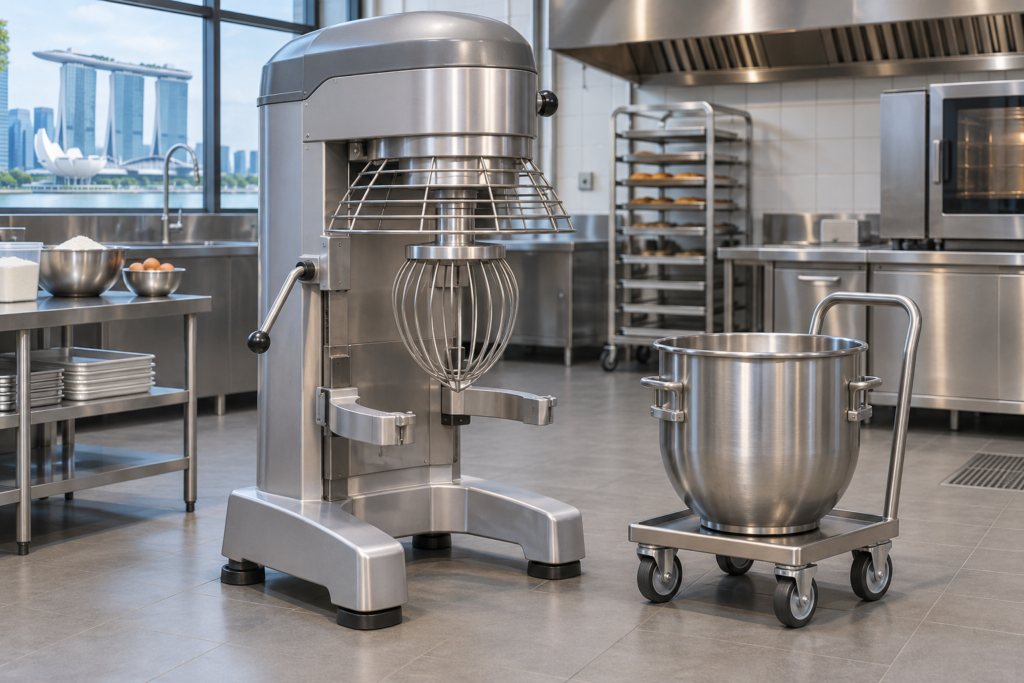
A planetary mixer can meet your recipe capacity and still leave the bakery team with a difficult handoff between mixing and portioning. The bowl needs to leave the machine, follow a usable route and arrive at a working height that suits the next operation. Before seeking a quote, map that handoff with the team that will use it. Confirm which pieces of equipment will support the bowl and test the route with a representative load under the site’s approved handling procedures.
Measure the load that actually moves
Record the working batch weight and ask for the weight of the empty bowl for the proposed mixer. Document any attachment or liner that remains with the load during transfer. Separate those numbers from the mixer’s stated capacity. The person moving the bowl needs to account for its full moving weight, how it is gripped and the height changes on the route. Hobart’s capacity calculator illustrates how one manufacturer sizes mixers against recipe and batch inputs. Ask your own supplier for the relevant documentation rather than using that calculator to infer the capacity of a different model.
Observe the process with a light batch and a heavier one under your site procedures. Note whether the bowl stays upright throughout and when the operator needs both hands. Document the difference between moving the full bowl and portioning directly from it at the station. If either method requires a second person or supporting equipment, put that dependency on the operations plan and the equipment brief.
Trace the route to portioning and wash-up
Start at the mixer and walk to the point where the contents are discharged. Mark tight corners, side-by-side working stations, floor transitions and doors staff may open during the move. Check where the empty bowl moves after portioning and where it will be stored once cleaned. A trolley that fits the outbound route may have nowhere suitable to wait during cleaning or while another bowl is being mixed.
Confirm the interfaces between equipment
Ask which parts support the bowl at each handoff. Determine whether the proposed mixer has an included support or lift arrangement and which trolley or carrier the supplier specifies for the actual bowl. Verify compatible part numbers and dimensions in writing. Show the supplier the receiving surface and its intended use. If the trolley has to dock at a station, check the working heights and approach with the people who will use it.
Include a plan for a second bowl if shifts overlap. Ask where the spare will be stored, when it is needed and whether the trolley can return before the next batch finishes. The benefit of a spare bowl may depend on whether there is space to stage it without losing access to the portioning station.
Make the demonstration a purchase requirement
Ask for a demonstration of the approved bowl coupling, release and transfer for the quoted configuration. Have a responsible person assess the handling method and choose appropriate conditions for the trial. Stop and consult the supplier if fit or stability is unclear. Document what was tested, what part numbers were used and which tasks still require training. If the site route is unavailable for the demonstration, record that difference and leave a site check as an open item.
Compare quotations by setting the same transfer outcome for every supplier. Put bowl, trolley, any accessories and operator familiarisation on distinct lines. Mark what has been included and what remains separately sourced. Ask each supplier to identify the documentation that applies to the whole combination. A clear list lets you see how the proposed configuration gets the batch from machine to work surface.
Frequently asked questions
Does the mixer bowl volume tell me the load weight?
Record a production batch mass separately and ask for the empty bowl weight. The same volume can represent different practical loads depending on the recipe and how full the bowl is. Keep production capacity and handling checks separate on the quotation.
Can we reuse a bowl trolley from another mixer?
Ask the supplier to identify a supported bowl and trolley combination. Clearances, fit and allowed loads need confirmation for the exact components. Include the part numbers and let the team check the complete route with the confirmed setup.
Which dimensions should I send first?
Send the current mixer position, finished height and approach to the destination, narrow points on the path and the available storage area. Include the bowl and trolley details for any equipment you want to reuse.
Ask for a complete mixer handoff quote
See the U-Save planetary mixer page and send your batch and handling brief. Include recipe type, usual and largest batch weights, route sketch and transfer method. Ask which bowl and handling equipment are included and which movements need to be demonstrated before acceptance.