
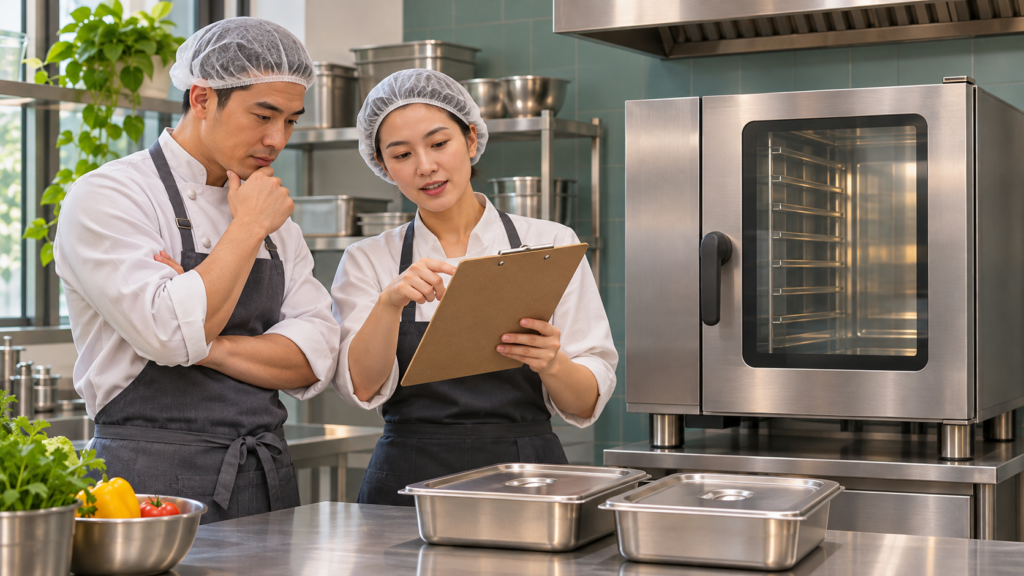
A combi oven demonstration is most useful when it answers a question from your own kitchen. Can the proposed setup produce enough portions of your busiest dish, at the quality you need, before the next order wave? A tray count or a polished demonstration menu cannot answer that question on its own.
For a Singapore restaurant, café or caterer comparing equipment quotes, a menu trial gives the chef, operations manager and buyer a common set of observations. Use it to decide which configuration merits a quote, which needs another test, and which does not fit the planned service. The steps below work whether the supplier can arrange a trial or you are preparing a brief to discuss available options.
Turn your menu into a test brief
Choose one item that sets the pace during a real service period. A café might choose the dish that sells steadily through lunch. A catering kitchen might choose the batch item that must be ready before dispatch. If the equipment will serve more than one station, add a second item with a different requirement so that a strong result on the easiest dish cannot decide the purchase.
Write down the portion size, preparation state, intended pan or rack, expected load and time by which the batch needs to be ready. Bring the recipe or a description detailed enough to reproduce the portion and preparation method. Use your own production records to set the target. A projected sales figure or the total number of trays that fit inside the cavity is less informative than what your kitchen actually needs to finish in a defined window.
Describe the change you expect the equipment to support. For example, you might need to finish two smaller runs for successive order waves, or free a cook for plating while another item is in the oven. Test that operating pattern if it is central to the purchase.
Agree on what counts as a usable batch
Before the demonstration, agree on how the chef will judge portion quality and how your team will verify the applicable food safety checks. Use your established food safety procedures, the manufacturer’s instructions and the advice of the person responsible for food safety. A favourable visual result cannot substitute for those checks.
Decide which qualities matter at the point of service. A sample that looks good immediately after unloading may be less useful to a caterer if it falls short after the actual holding step. Record when the sample is assessed and check portions from different positions within the load. Keep the criteria narrow enough that two people can apply them consistently.
A useful brief names the result you want, who will assess it and what would trigger a repeat. For example, you might repeat the trial if the chef must sort out unacceptable portions, if loading takes more handling than your shift allows, or if the equipment is tested with a different pan from the one proposed in the quote.
Compare under the same operating conditions
Ask which exact oven and accessories the supplier can make available for the trial. Record the configuration used and have the supplier flag differences from the proposed purchase. An observation from one setup should not silently become a promise about another.
Use the same recipe, preparation state, portion size and acceptance criteria across comparable runs. If a supplier recommends a different process, write down the difference and why it matters. Separate trials designed to compare two configurations from trials designed to improve a recipe. Otherwise, a change in the result may be hard to attribute.
Convotherm’s Australian demonstration programme illustrates how a manufacturer can tailor a demo to a buyer’s objectives. For a Singapore purchase, ask the supplier what testing or evidence is available for the specific setup you are considering.
Record elapsed time and staff involvement separately
Track the time from the start of loading to the point when the accepted portions are ready for the next service step. If preheating, loading, unloading or reset affects when your team can start the next batch, record it separately. Count usable portions once and note rejects or rework.
Also record when staff must intervene. A cook may be able to do other work during part of a cycle, but may need to be present for both loading and unloading. That distinction matters when the same person is also expected to plate or prepare the next batch.
| Record | What to write down |
|---|---|
| Dish and load | Recipe, portion size, starting condition and pans used |
| Setup | Exact equipment and accessories tested, plus deviations from the quote |
| Timing | Load, finish, ready-for-service and next-batch availability |
| Result | Portions accepted, issues observed and relevant food safety checks |
| Staffing | Tasks that require someone to be present and when |
| Decision | Accept the result, repeat with one change, or request another configuration |
Repeat the busiest realistic load if possible. If the second run falls short, note what changed before assuming the first result is repeatable. When testing mixed dishes, confirm that their procedures and timing are compatible for the proposed model before combining them.
Put the findings in the quote request
Share the trial notes alongside the equipment configuration. Ask the supplier to identify the included accessories, any site requirements, the documentation that applies to the model and who is responsible for installation and handover. If your decision depends on an assumption that the test did not cover, write it as an open question.
A practical procurement decision might be to request a quote for the tested setup, arrange another test at a more representative load, or compare a different configuration. Agree which evidence is needed before you commit. This is particularly useful if the chef observed a good result but the buyer received a quote for different accessories.
Frequently asked questions
Should we test the full menu?
Start with a small set that represents the hardest recurring work. Include another dish if the first cannot show a different constraint that matters to your purchase, such as handling, finish or turnaround between runs.
Can we calculate output from one successful batch?
Treat it as an observation for that load and setup. For planning, repeat the run and include the work between batches. Check that the output fits the order pattern and staffing of the service you are trying to support.
What if we cannot arrange a trial?
Send the menu brief and ask for model-specific documentation or evidence from comparable work. Record differences in load, accessories or staffing and keep any remaining assumptions open in the purchase decision.
Discuss your menu and load with U-Save
Browse the commercial combi oven category and contact U-Save F&B Equipment with your representative dishes, typical batch sizes, required service window and site constraints. Ask which equipment configurations can be quoted and what evidence is available to assess them against your kitchen’s workload.